Best of Classification2024

  1. 1
    Article
    Avatar of freecodecampfreeCodeCamp·2y

    Learn Machine Learning in 2024

    Learn machine learning in 2024 with a comprehensive course on the freeCodeCamp.org YouTube channel. The course covers machine learning basics, practical algorithms, and includes an end-to-end project in Python. It provides a clear roadmap for beginners and offers guidance for further learning.
  2. 2
    Article
    Avatar of dailydoseofdsDaily Dose of Data Science | Avi Chawla | Substack·2y

    10 Regression and Classification Loss Functions

    This post highlights the most commonly used loss functions in regression and classification tasks. It covers Mean Bias Error, Mean Absolute Error, Mean Squared Error, Root Mean Squared Error, Huber Loss, and Log Cosh Loss for regression. For classification, it discusses Binary Cross Entropy, Hinge Loss, Cross-Entropy Loss, and KL Divergence. Each loss function is briefly explained along with its pros and cons.

  3. 3
    Article
    Avatar of medium_jsMedium·2y

    Understanding Support Vector Machines: The Key to Powerful Classification

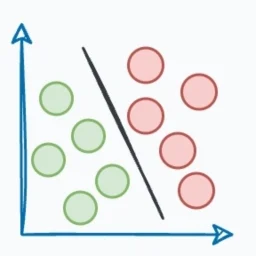
    Support Vector Machines (SVM) are a powerful classification tool in machine learning that aims to find the optimal decision boundary (hyperplane) to separate two classes of data while maximizing the margin between them. It handles both linearly and non-linearly separable data, using support vectors to determine the hyperplane's position and the kernel trick to transform data into higher dimensions for better separation. SVM is highly versatile, adaptable to real-world messy data with overlapping classes by introducing a soft margin.

  4. 4
    Article
    Avatar of kdnuggetsKDnuggets·2y

    5 Machine Learning Papers to Read in 2024

    Discover five machine learning papers recommended to read in 2024, including HyperFast for instant classification, EasyRL4Rec for user-friendly code library, ZLaP for zero-shot classification, Infini-attention for efficient infinite context transformers, and AutoCodeRover for autonomous program improvement.

  5. 5
    Article
    Avatar of dailydoseofdsDaily Dose of Data Science | Avi Chawla | Substack·2y

    A Popular Interview Question: Discriminative vs. Generative Models

    The post explains the fundamental differences between discriminative and generative models in machine learning. Discriminative models focus on learning decision boundaries for classification by maximizing the conditional probability P(Y|X), with examples like logistic regression and decision trees. Generative models, such as Naive Bayes and Gaussian Mixture Models, learn the joint probability P(X, Y) and can generate new samples. A quiz is included to further illustrate the concepts and differentiate between the two approaches.

  6. 6
    Article
    Avatar of palindromeThe Palindrome·2y

    Understanding k-Nearest Neighbors

    kNN is a lazy machine learning algorithm that doesn't require training. It makes predictions by calculating distances between new samples and training samples, finding the k nearest neighbors, and classifying the new sample based on a majority vote from those neighbors. The value of 'k' is important as it determines the number of samples considered for prediction. The choice of 'k' can have a significant impact on the outcome. Different distance metrics, such as Euclidean distance, Manhattan distance, and Minkowski distance, can be used in kNN depending on the problem. Cosine similarity is another distance metric that can be useful for high-dimensional data.

  7. 7
    Article
    Avatar of watercoolerWatercooler·2y

    Confusion Matrix for Classification is really a "CONFUSION" !!!!

  8. 8
    Article
    Avatar of medium_jsMedium·2y

    Linear Regression Model

    The linear regression model is a supervised learning algorithm used to predict numerical outputs like prices based on input features. It fits a straight line to the data and uses a training set to learn from the examples.

  9. 9
    Article
    Avatar of medium_jsMedium·2y

    The Softmax Activation Function with Keras

    The Softmax activation function is essential for neural networks dealing with multiclass classification. It converts logits, the outputs of the last layer of a neural network, into a discrete probability distribution over target classes. Softmax ensures probabilities are nonnegative and sum to 1. By learning to maximize logit outputs, models improve their accuracy in class predictions. This post explains Softmax's working, its importance in neural networks, and demonstrates its implementation in Keras.

  10. 10
    Article
    Avatar of dailydoseofdsDaily Dose of Data Science | Avi Chawla | Substack·2y

    Why Traditional kNN is Not Suited for Imbalanced Datasets

    Traditional kNN is highly sensitive to the hyperparameter k, which can lead to inaccurate predictions on imbalanced datasets. Two techniques to improve kNN are distance-weighted kNN, which weighs neighbors by distance, and dynamically updating k, which adjusts k based on the class distribution within the nearest neighbors. Both methods aim to make kNN more robust and effective for datasets with class imbalance.

  11. 11
    Article
    Avatar of dailydoseofdsDaily Dose of Data Science | Avi Chawla | Substack·2y

    A Simple Technique to Understand TP, TN, FP and FN

    Learn a simple technique to understand TP, TN, FP, and FN in binary classification models. Also, explore other special techniques for labeling binary classification predictions.

  12. 12
    Article
    Avatar of tdsTowards Data Science·2y

    Metrics to Evaluate a Classification Machine Learning Model

    Evaluating a classification machine learning model involves understanding various performance metrics like precision, recall, F1 score, and accuracy. Precision helps measure the proportion of correct positive predictions, while recall assesses the model's ability to catch actual positive cases. Accuracy can be misleading in imbalanced datasets, like fraud detection, making metrics like precision and recall more reliable. The confusion matrix is a critical tool in visualizing these outcomes.

  13. 13
    Article
    Avatar of dailydoseofdsDaily Dose of Data Science | Avi Chawla | Substack·2y

    Rank-Consistent Classifiers

    Rank-consistent classifiers address the shortcomings of cross-entropy loss functions in multiclass classification tasks where class labels have an inherent order, such as age groups. These models ensure predicted probabilities align with the natural ordering of labels, improving performance and interpretability in ordinal datasets.