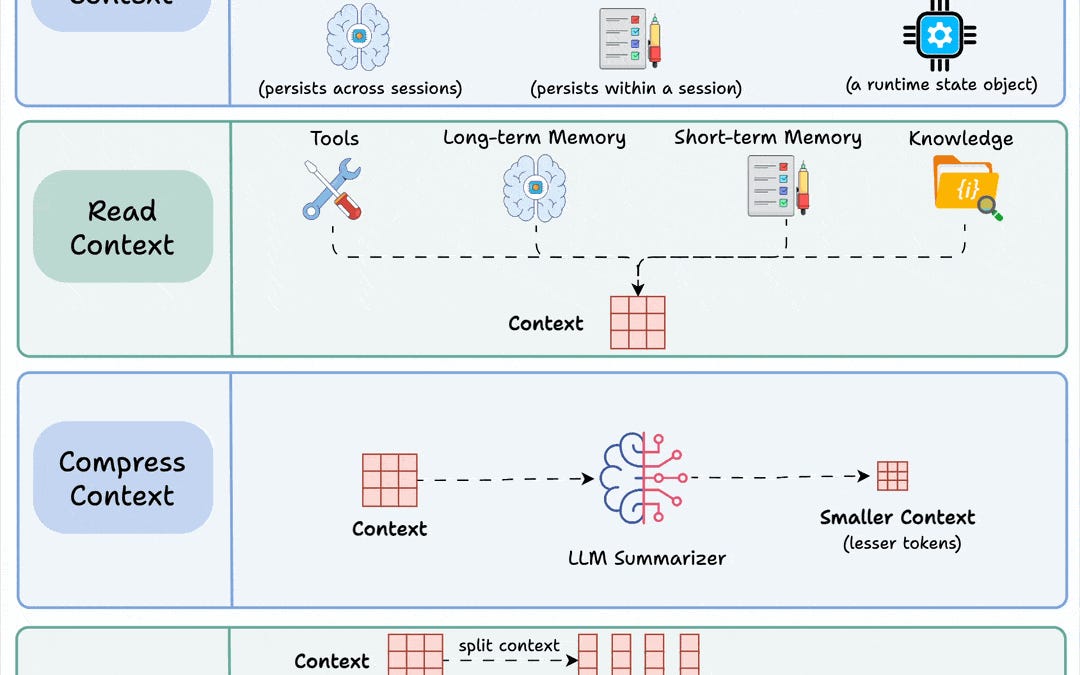
Context engineering is the practice of delivering the right information, in the right format, at the right time to an LLM. Unlike simple prompting, it involves managing six types of agent context: instructions, examples, knowledge, memory, tools, and guardrails. The process breaks down into four stages: writing context (saving to memory or state), reading context (pulling from tools, memory, or knowledge bases), compressing context (removing redundant tokens via summarization), and isolating context (splitting across sub-agents or sandboxes). The analogy used is that if an LLM is a CPU, the context window is RAM — and context engineering is programming that RAM optimally.
Sort: