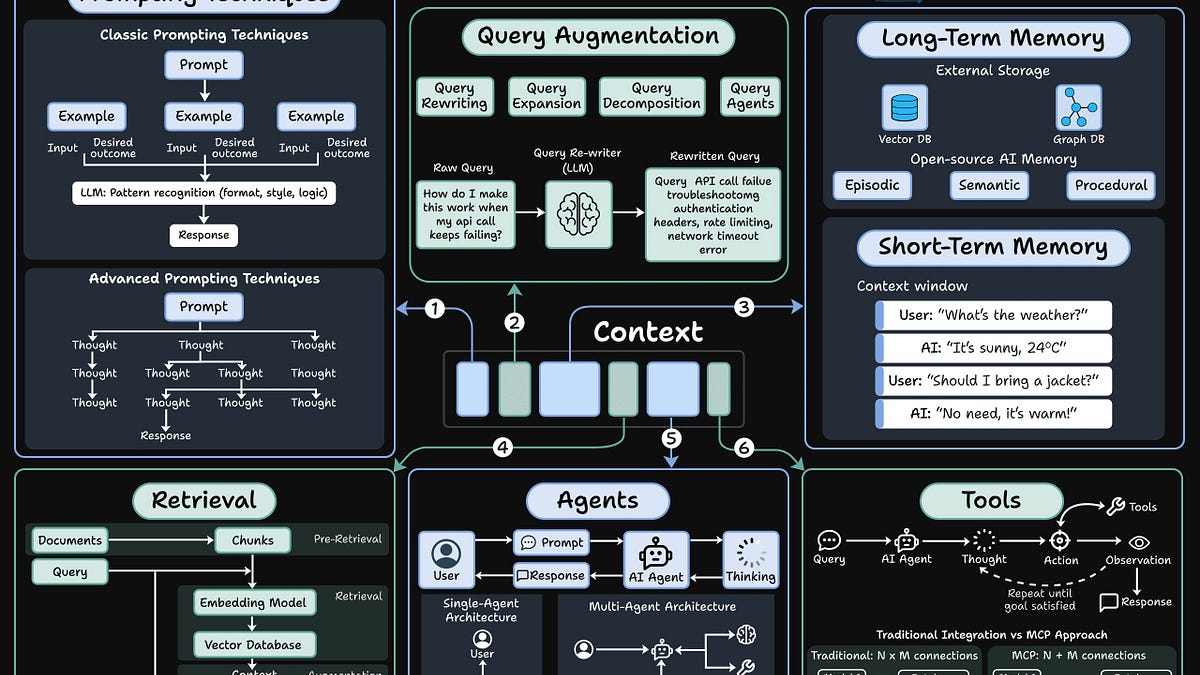
Context engineering is the practice of optimizing how information flows to AI models, comprising six core components: prompting techniques (few-shot, chain-of-thought), query augmentation (rewriting, expansion, decomposition), long-term memory (vector/graph databases for episodic, semantic, and procedural memory), short-term memory (conversation history management), knowledge base retrieval (RAG pipelines with pre-retrieval, retrieval, and augmentation layers), and tools/agents (single and multi-agent architectures, MCPs). While model selection and prompts contribute only 25% to output quality, the remaining 75% comes from properly engineering these context components to deliver the right information at the right time in the right format.
3 Comments
Sort: